
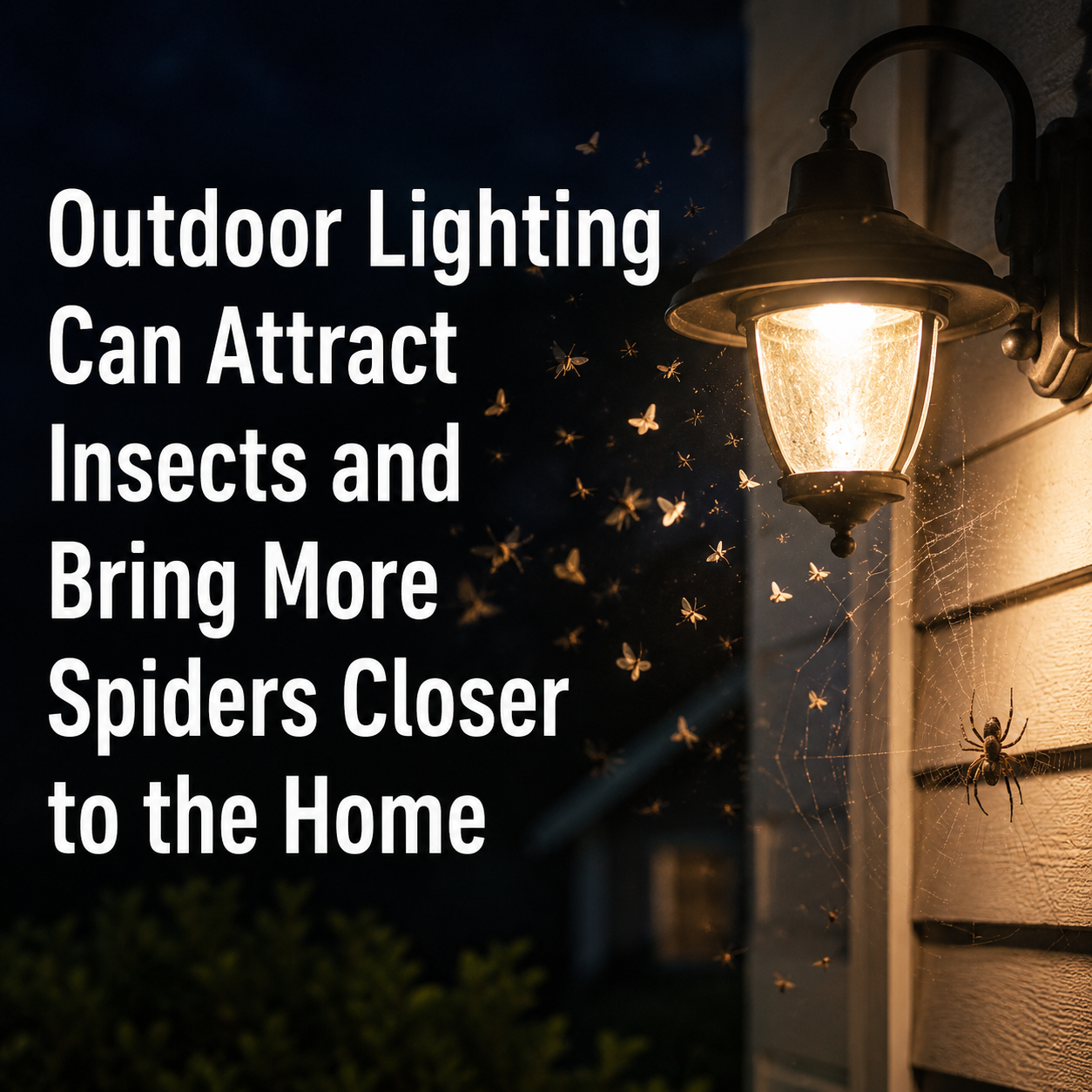
Many homeowners notice the same pattern every summer evening. As soon as the outdoor lights switch on, insects begin circling windows, doors, patios, and garages. Not long after, spider webs start appearing near entryways, light fittings, and outdoor furniture. This is not a coincidence.
Outdoor lighting can unintentionally create the perfect hunting ground for spiders by attracting the insects they feed on. While spiders are not usually drawn directly to light itself, they are highly attracted to areas where insects gather in large numbers. Artificial lighting effectively creates a steady food source close to the home. Understanding how lighting affects insect and spider activity can help reduce pest problems before they become harder to manage.
Why Outdoor Lights Attract Insects
Most flying insects naturally use moonlight and other natural light sources for navigation. Artificial lights interfere with this behaviour, causing insects to become disoriented and gather around illuminated areas.
Bright white lights, cool-toned LEDs, fluorescent globes, and ultraviolet light sources are particularly attractive to moths, mosquitoes, flies, and beetles. The stronger and brighter the light, the larger the insect activity often becomes. Outdoor lighting around doors, pathways, patios, garages, and gardens creates concentrated insect activity directly beside the home. This naturally increases the likelihood of spiders moving closer as well.
Why Spiders Follow the Insects
Spiders are predators. They go where food is abundant. Spiders are not usually attracted to the light itself. Instead, they position themselves near light sources because insects gather there in large numbers.
This is why spider webs commonly appear around porch lights, garage lights, outdoor entertaining areas, and illuminated windows. For spiders, these locations provide reliable feeding opportunities with minimal effort. Over time, outdoor lighting can increase spider activity around the home’s exterior and may eventually lead to more spiders entering indoors through nearby gaps, doors, and windows.
Areas Around the Home Most Commonly Affected
Some parts of the property are especially vulnerable to increased spider activity caused by lighting. Entryways are one of the biggest problem areas because lights near front and back doors attract flying insects overnight. Spiders then build webs around door frames, eaves, and nearby walls.
Patios and outdoor entertaining spaces are also common hotspots. Consistent evening lighting creates a stable feeding environment for insects and spiders alike. Garage lights often contribute to pest activity because they remain switched on for long periods.
Similarly, garden lighting placed close to shrubs or dense vegetation can increase insect concentration near natural spider hiding spots. Homes with excessive exterior lighting usually experience more persistent web formation and higher visible spider activity.
The Risks of Increased Spider Activity
Most spiders found around Australian homes are harmless. However, larger spider populations can still create problems. Frequent web building around entrances, windows, and outdoor furniture quickly becomes difficult to manage. Webs also trap dirt, dust, and dead insects, making outdoor areas look neglected.
Some spider species commonly found around homes can deliver painful bites if disturbed accidentally. Increased spider activity near doorways, garages, or children’s play areas raises the likelihood of unwanted encounters.
Large insect populations attracted by lighting can also create broader pest issues beyond spiders, including mosquitoes and other nuisance insects. In some cases, recurring infestations may require professional spider pest control if environmental conditions continue encouraging pest activity around the property.
How Lighting Choices Affect Pest Activity
Not all outdoor lighting attracts insects equally. Cool white and blue-toned lights tend to attract more insects because many flying insects respond strongly to shorter light wavelengths.
Warmer lighting options, such as amber, yellow, or warm LED bulbs, attract fewer insects and may help reduce spider activity indirectly. Bug lights designed with warmer colour temperatures are commonly recommended for this reason.
Brightness also matters. Extremely bright lights create larger insect gathering zones, while dimmer lighting reduces attraction levels. Motion-sensor lighting can also help by reducing the amount of time lights remain active overnight.
Practical Ways to Reduce Spiders Around Outdoor Lights
Reducing spider activity starts with limiting the insects that attract them. Switching to warm-coloured LED globes is one of the simplest changes homeowners can make. Amber or yellow lighting generally attracts fewer insects than bright white bulbs.
Limiting unnecessary outdoor lighting also helps. Leaving lights on throughout the night creates a constant food source for spiders. Cleaning outdoor light fittings regularly removes webs, egg sacs, and insect debris that may encourage repeat activity.
Trimming vegetation near walls, windows, and lights also reduces hiding places for spiders close to entry points. Sealing cracks around doors and windows can further reduce the chances of spiders moving indoors from outdoor areas.
When Spider Activity Becomes a Larger Problem
Occasional spiders outdoors are normal. However, consistent heavy web formation, repeated indoor sightings, or rapidly increasing spider populations may indicate broader pest activity around the property.
Outdoor lighting alone is rarely the only cause. Moisture, clutter, dense vegetation, and insect infestations often contribute as well. If the problem continues despite reducing attractants, professional pest inspections may be necessary to identify underlying causes and manage infestations effectively.
FAQs
1. Do outdoor lights directly attract spiders?
No. Spiders are usually attracted indirectly because lights attract the insects they feed on.
2. What types of lights attract the most insects?
Bright white, cool-toned, fluorescent, and blue-spectrum lights generally attract the highest number of insects.
3. Do LED lights attract spiders?
LED lights usually attract fewer insects than older lighting types, but cool white LEDs can still contribute to spider activity.
4. What light colours help reduce insect activity?
Warm yellow, amber, and soft white lights are typically less attractive to insects.
5. Can outdoor lighting cause spiders to enter the house?
Yes. Increased insect activity near doors and windows can encourage spiders to move closer and eventually indoors.
6. When should I consider professional spider pest control?
Professional help may be needed if spider activity becomes frequent, widespread, or difficult to manage despite preventative measures.


